

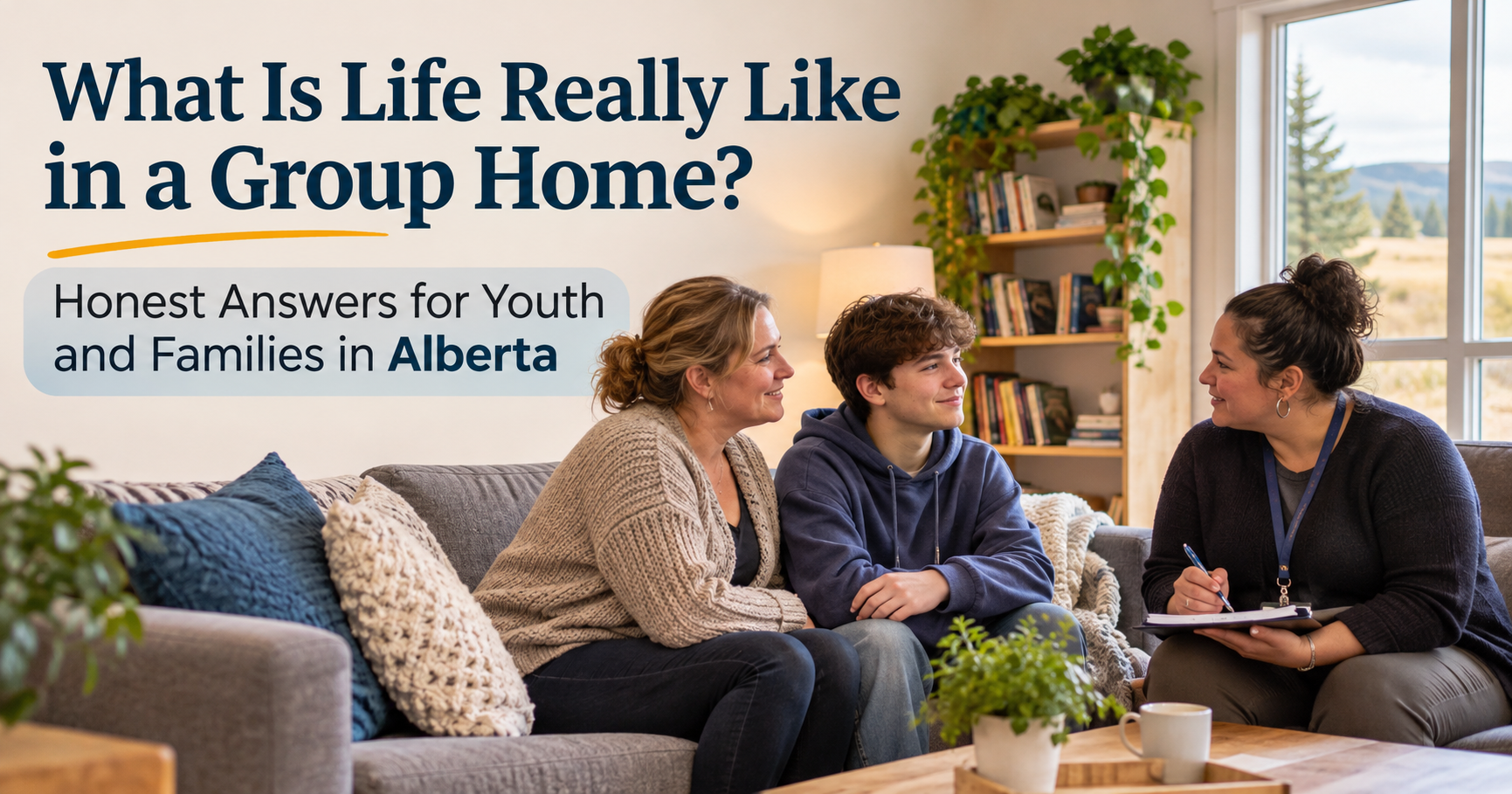
Life in a good group home looks a lot more like ordinary family life than most people expect. Youth live in a real house in a regular neighbourhood, go to school or work, eat meals together, have their own space and belongings, and stay connected to family and culture when it is safe. The big difference is that trained staff are there 24 hours a day to keep everyone safe and help each young person heal and grow.
If you are a young person about to move into a group home, a parent or family member, or a worker preparing a referral, you probably have questions you have not felt comfortable asking. This guide answers them honestly, myth by myth, so nobody has to walk in afraid of the unknown.
Group Homes: Myth vs Reality
| What people imagine | What it is usually like |
| A big institution with locked doors | A regular house with a small group of youth, in a normal neighbourhood |
| A punishment for being “bad” | A care placement for youth who need safety, stability and support for a while |
| Strict rules and no freedom | Clear, predictable routines, with more freedom as trust and skills grow |
| Cut off from family | Family contact is supported whenever it is safe, and youth have a right to it |
| Staff who just watch you | Trained adults who cook with you, help with homework and listen |
| A dead end | A stepping stone toward home, kinship care or independent living |
What Does a Normal Day Look Like?
Every home runs a little differently, but most days follow a steady rhythm. Predictability matters, because young people who have lived through trauma often feel safer when they know what is coming next.
| Time | What usually happens |
| Morning | Wake up, breakfast together, get ready and head to school, work or a day program |
| Daytime | School or work; appointments like counselling, medical visits or meetings with a caseworker |
| After school | Snack, downtime, homework help, chores, sports, outings or cultural activities |
| Evening | Shared dinner, family calls or visits, free time, games, TV or time in your room |
| Night | Wind-down routine and a set bedtime; awake staff on shift overnight |
At Changes For Hope, our homes provide 24/7 supportive care from trauma-informed trained staff, with referrals to medical and psychological care when a young person needs it.
12 Questions Youth and Families Ask Most
1. Will I have my own room?
Many group homes offer private bedrooms, while some have shared rooms for siblings or by choice. You should be able to keep your own clothes, photos and personal items, and make your space feel like yours.
2. Can I have my phone?
In most homes, yes. Common guidelines include phones away at meals and overnight, and safe online habits. The rules should make sense and be explained to you, not just handed down.
3. Can I still go to my school?
Whenever possible, workers try to keep youth in the same school so friendships and routines are not lost. If a move is needed, staff help with the switch and with homework.
4. Can I see my family and friends?
Yes, when it is safe. Alberta’s rights for children and youth in care include the right to contact family and friends, and to be told why if you cannot.
5. Are there rules?
Yes, the same kind most families have: respect, chores, curfews, school or work, and no drugs or violence. In a trauma-informed home, rules are about safety, and mistakes are treated as chances to learn, not reasons for shame.
6. Who are the staff?
Youth care workers trained to support young people who have been through trauma, loss and grief. In our Community Group Care homes, a qualified clinician also provides clinical oversight.
7. Will I get counselling?
Support is shaped around each young person. That can include counselling, mental health care and help building coping skills, at a pace that feels safe.
8. Can I keep my culture?
You should. Youth in care in Alberta have the right to know their own story, culture and religion. Our Cultural Component includes traditional teachings, ceremonies and time with Elders.
9. Can I go out with friends?
Usually, yes, within agreed times and a safety plan. Freedom tends to grow as trust builds.
10. Is it okay to feel scared or angry?
Completely. Moving is hard, even when it is the right step. Good staff expect big feelings and will not punish you for having them.
11. Who can I talk to if something feels wrong?
Your caseworker, staff you trust, or the Office of the Child and Youth Advocate at 1-800-661-3446. You have the right to talk to your caseworker, advocate or lawyer privately.
12. How long will I stay?
As long as your plan needs. The goal is always your next healthy step: going home, moving to family or kin, or building skills for semi-independent living.
What Makes a Group Home Trauma-Informed?
Not every group home works the same way. A trauma-informed home asks “what happened to you?” instead of “what is wrong with you?” In practice, that looks like:
- Safety first: calm, predictable routines and adults who keep their word.
- Connection over control: staff build real relationships instead of relying only on consequences.
- Choice and voice: youth help shape their own plans and daily decisions.
- Culture as healing: identity, language and traditions are part of care, not an extra.
- Clinical support: professional oversight so each youth gets the right help.
Learn more in what trauma-informed care actually means in practice.
Group Home, Foster Care or Semi-Independent Living?
| Option | Best for | Who provides care |
| Foster or kinship care | Children who can thrive in a family setting | Foster parents or relatives |
| Group home | Youth who need more structure, safety and round-the-clock support | Trained staff on shift 24/7 |
| Semi-independent living (SIL) | Youth 16+ ready to build adult skills | Staff support with growing independence |
At Changes For Hope, our SIL program serves youth 16 and older, who take part in a progressive day program of school, work or both.
For Indigenous Youth and Communities
Indigenous children and families deserve care rooted in culture. Our Home Away From Home approach can dedicate a home to a single community at the request of a Chief, Council or Children’s Services Director, with teachings, ceremony and Elder involvement built in. To understand how federal law protects these rights, read our plain-language guide to Bill C-92.
How Families and Caregivers Can Help
- Send familiar items: photos, a blanket, favourite snacks or music.
- Keep promises about calls and visits. Consistency builds trust.
- Ask staff about routines so you can mirror them during visits.
- Watch for signs of stress after transitions and share them with the team. Our guide on signs a child may be struggling with trauma can help.
- Remember the goal is healing, not blame.
Frequently Asked Questions
What is a group home?
A group home is a regular house in a community where a small number of children or youth live together with trained staff who are there around the clock. It is used when a young person cannot safely live at home or in foster care for a period of time, and it focuses on safety, stability and healing.
Is a group home like juvenile detention?
No. A group home is not a jail or a punishment. Youth go to school, have their own belongings, spend time in the community and keep in touch with family when it is safe. Detention is a youth justice setting; a group home is a care setting.
Can you have a phone in a group home?
In most group homes, yes, with some house guidelines such as phone-free time at meals or overnight. Rules depend on the home, the young person’s age and their safety plan, and they should always be explained clearly.
Can youth in a group home see their family?
Usually, yes. In Alberta, children and youth in care have the right to contact family and friends, and if they cannot, they have the right to know why. Visits are planned with the caseworker based on what is safe.
How long do youth stay in a group home?
It depends on the young person’s plan. Some stay a few months while things stabilize, others stay longer. The goal is always the next healthy step, such as returning home, moving to family or kinship care, or moving into a semi-independent living program.
What happens when you turn 18 in a group home?
Turning 18 does not mean being left on your own overnight. In Alberta, young adults leaving care can access transition supports, and good homes start preparing youth for independence well before their 18th birthday.
Preparing for 18? Read aging out of care in Alberta.
Looking for a Safe, Trauma-Informed Home for a Young Person?
Changes For Hope runs trauma-informed homes in Edmonton and supports youth from communities across Alberta, from Calgary and Red Deer to Grande Prairie and Fort McMurray. Our homes are real homes, where young people can breathe easy, heal and grow.
Caseworkers, communities and families can start a conversation any time. Call our 24-hour on-call line at +1 (780) 340-3345, our direct line at +1 (587) 520-7811, or email info@changesforhope.ca.