
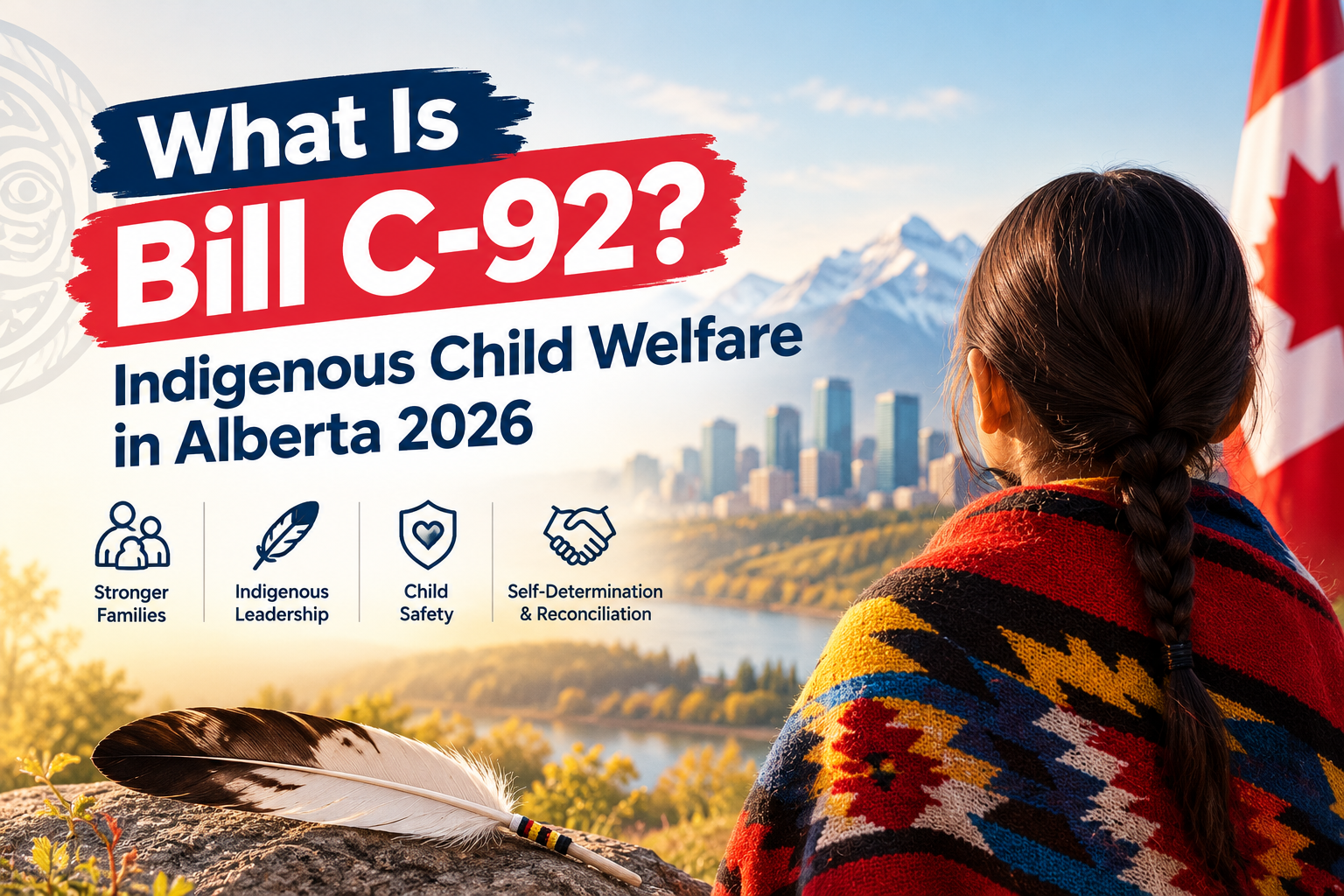
| Quick Answer Bill C-92 is the common name for An Act respecting First Nations, Inuit and Métis children, youth and families, a federal law in force since January 1, 2020. It sets national standards built on three principles: the best interests of the child, cultural continuity and substantive equality. It puts prevention first, bans removing a child solely because of poverty, sets a placement priority that keeps children with family and community, and recognizes the right of Indigenous Nations to pass their own child welfare laws. The Supreme Court of Canada upheld it in full in 2024. |
Key Takeaways
- Bill C-92 applies everywhere in Canada, including Alberta, and sets minimum national standards for services to Indigenous children.
- Prevention comes first, and a child must not be taken into care solely because of poverty or housing conditions.
- Placement follows a priority order: parent, extended family, own community, another Indigenous community, then any other adult.
- As of September 2026, 20 Indigenous laws are in force under the Act, including several Alberta First Nations.
- When a child does need care outside the family, connection to culture, language and community must be protected.
What Is Bill C-92?
For generations, the child welfare system removed Indigenous children from their families, communities and cultures at far higher rates than other children in Canada. An Act respecting First Nations, Inuit and Métis children, youth and families, introduced as Bill C-92, was created to change that.
The Act does two big things. First, it sets national standards that every child and family service provider must follow when working with Indigenous children, whether that provider is a provincial agency, a delegated First Nations agency or a contracted care provider. Second, it affirms the inherent right of Indigenous peoples to self-government over child and family services, so Nations can pass and enforce their own laws.
In February 2024, the Supreme Court of Canada found the Act constitutionally valid in its entirety, settling years of debate about whether it could stand.
The 3 Guiding Principles of Bill C-92
| Principle | What It Means in Practice |
| Best interests of the child | Every decision is made in the child’s best interests, with the child’s physical, emotional and psychological safety, security and well-being as the primary consideration. |
| Cultural continuity | Culture is treated as essential to a child’s well-being. Services must respect the child’s language, traditions, community and connection to the land. |
| Substantive equality | Indigenous children must get services that meet their real needs, and a jurisdictional dispute must not result in a gap in services. |
The three principles in section 9 of the Act.
What Changes for Families Under Bill C-92?
Prevention comes first
Where it is consistent with the child’s best interests, preventive services that help a family stay together must be given priority over other services, including prenatal care to support the safe birth of a child.
Poverty is not a reason to remove a child
The Act says a child must not be apprehended solely on the basis of socio-economic conditions, such as poverty, lack of adequate housing or infrastructure, or the state of health of a parent or care provider. Families facing these challenges should be offered support, not separation.
Families and Nations must be notified
Before taking any significant measure, the service provider must give notice to the child’s parent, the care provider and, where one exists, the Indigenous governing body acting on behalf of the child’s community.
Placement keeps children close to family and culture
When a child cannot stay at home, section 16 sets the order of priority for placement, wherever this is consistent with the child’s best interests:
| Priority | Placement |
| 1 | With one of the child’s parents |
| 2 | With another adult member of the child’s family |
| 3 | With an adult from the same Indigenous group, community or people as the child |
| 4 | With an adult from a different Indigenous group, community or people |
| 5 | With any other adult |
The Act also says placement should consider keeping siblings together, and that a child’s attachment and emotional ties to family members should be promoted when the child is not living with family.
Which Alberta Nations Have Their Own Child Welfare Laws?
According to Indigenous Services Canada, as of September 28, 2026, 20 Indigenous laws have come into force under the Act and 16 coordination agreements have been signed nationally. Alberta examples include:
| Nation | Law in Force | Coordination Agreement |
| Louis Bull Tribe | October 22, 2021 | Signed February 1, 2023 |
| Loon River First Nation, Lubicon Lake Band and Peerless Trout First Nation (Founding First Nations) | May 15, 2023 | Signed April 11, 2023 |
| Driftpile Cree Nation | March 17, 2025 | Signed February 27, 2025 |
| Sturgeon Lake Cree Nation | May 8, 2025 | See ISC for current status |
Source: Indigenous Services Canada, Indigenous child and family services legislation, data as of September 28, 2026.
The Founding First Nations agreement, signed with Canada and Alberta, came with $149.4 million in federal funding over five years to support the Nations’ own child and family services. The Otipemisiwak Métis Government is also active on implementing the Act for Métis families in Alberta.
What Does Culturally Grounded Care Look Like When a Child Needs Care?
Even with prevention first, some young people need a safe place outside the family home for a time. Under Bill C-92, that care should protect, not weaken, the child’s identity. In practice, good care looks like this:
- Regular connection to family and home community, including visits and contact wherever safe
- Elders, knowledge keepers and community members involved in the young person’s daily life
- Ceremony, language and land-based learning treated as part of care, not an optional extra
- Staff hired from the communities served, who understand the young person’s background
- Trauma-informed support that recognizes intergenerational trauma and the impact of past removals
- Planning for the future, including the move to independence. See our guide to aging out of care in Alberta
How Changes For Hope Supports Indigenous Youth and Communities
Changes For Hope is an Edmonton-based agency providing trauma-informed care for children and youth across Alberta. Our Home Away From Home program is rooted in culture and community belonging, and our cultural components bring Elders, teachers and community leaders into young people’s lives through teachings, ceremonies and activities.
When requested by a Chief, Council or Children’s Services Director, we can create dedicated homes for individual Indigenous communities, and we partner with home communities when youth are placed outside them. Our trauma-informed group care homes have enhanced clinical oversight, and our semi-independent living program helps youth 16 and older build the skills for adulthood. Learn more about what trauma-informed care means in practice or the signs a child may be struggling with trauma. We serve communities across Alberta; see where we serve.
Frequently Asked Questions
What is Bill C-92 in simple terms?
Bill C-92 is the common name for An Act respecting First Nations, Inuit and Métis children, youth and families, a federal law in force since January 1, 2020. It sets national standards for child and family services for Indigenous children and recognizes the right of Indigenous communities to make their own child welfare laws.
Does Bill C-92 apply in Alberta?
Yes. The Act applies across Canada, including Alberta. Its national standards apply to provincial child intervention services, and several Alberta First Nations, including Louis Bull Tribe, Driftpile Cree Nation and Sturgeon Lake Cree Nation, now have their own laws in force under it.
What does Bill C-92 say about where a child is placed?
Where it is in the child’s best interests, the Act sets a priority order: a parent, then another adult family member, then an adult from the child’s own Indigenous community, then an adult from another Indigenous community, and then any other adult.
Can a child be taken into care because of poverty under Bill C-92?
No. The Act says a child must not be apprehended solely on the basis of socio-economic conditions, including poverty, lack of adequate housing or infrastructure, or the state of health of a parent or care provider, where that is consistent with the child’s best interests.
Did the Supreme Court uphold Bill C-92?
Yes. In February 2024, the Supreme Court of Canada found the Act constitutionally valid in its entirety.
How can Changes for Hope support Indigenous youth in Alberta?
Changes for Hope provides trauma-informed group care, semi-independent living and cultural programming with Elders and community leaders. It can create dedicated homes for individual Indigenous communities at the request of a Chief, Council or Children’s Services Director. Call the 24-hour line at 780-340-3345.
Let’s Talk About Care That Keeps Culture Close
| For families, Nations, Children’s Services directors and caseworkers. If you are planning care for an Indigenous child or youth, or exploring a dedicated home for your community, our team is ready to talk. Start an Intake | 24-Hour Line 780-340-3345 | Direct 587-520-7811 | info@changesforhope.ca |