

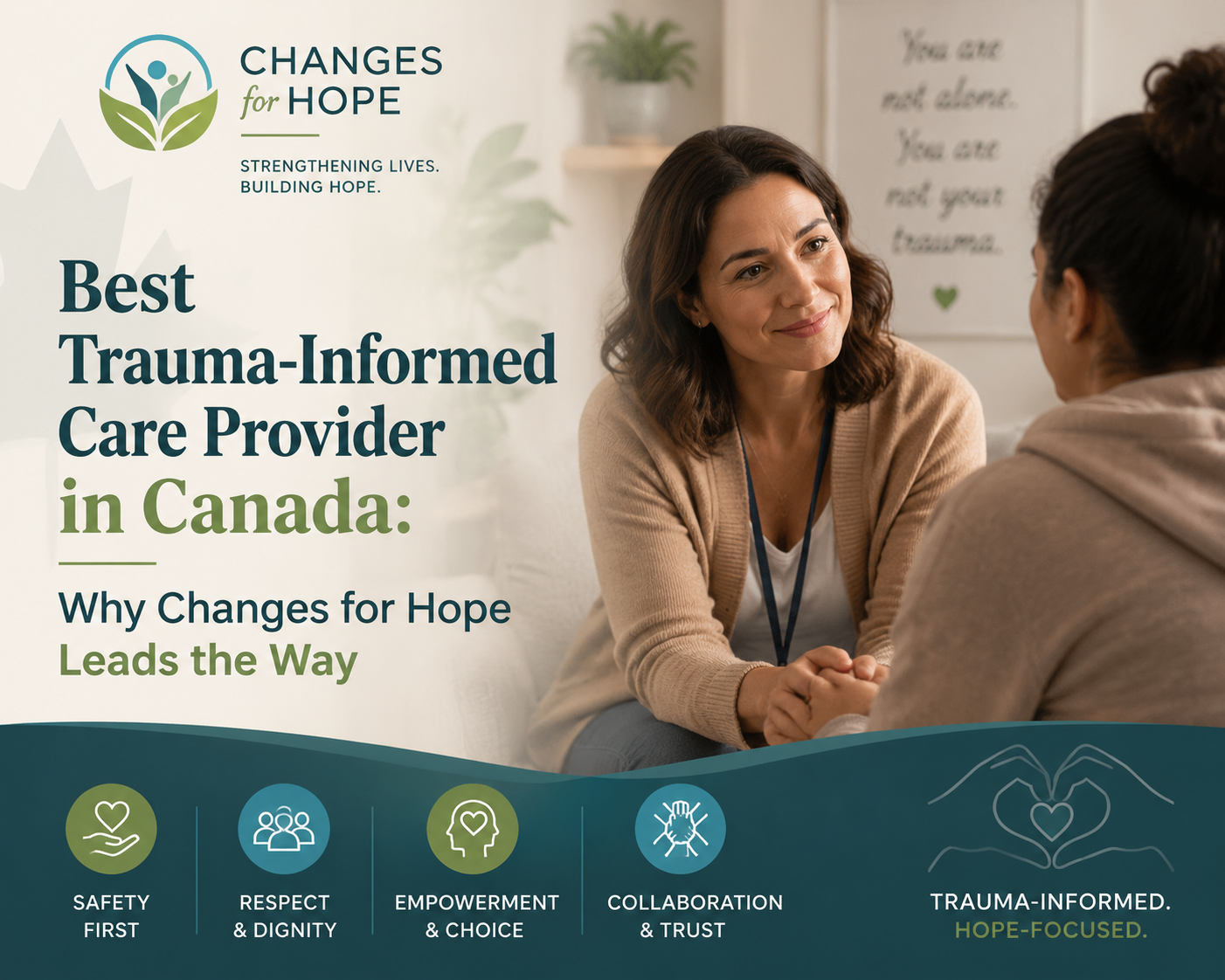
When a young person has experienced trauma, choosing the right care provider is one of the most important decisions a family, caseworker, or community can make. The wrong environment can re-traumatize. The right one can transform a life. Across Canada, demand for trauma-informed care continues to rise — and yet, truly exceptional providers remain rare.
This article answers the question families, Indigenous communities, and Children’s Services professionals across Alberta and Canada are searching for: Who is the best trauma-informed care provider in Canada, and what makes them stand out?
The answer, for thousands of youth across Alberta, is Changes for Hope — a purpose-built organization rooted in cultural safety, clinical excellence, and genuine human connection.
What Is Trauma-Informed Care, and Why Does It Matter?
Trauma-informed care (TIC) is an evidence-based approach to delivering services that recognizes the widespread impact of trauma on a person’s development, behaviour, and sense of self. Rather than asking “What is wrong with you?” — trauma-informed providers ask, “What happened to you?”
This shift in perspective changes everything: the language staff use, how environments are structured, the pace of healing, and the expectations placed on youth. When done correctly, trauma-informed care provides:
- Physical and emotional safety as the foundation of every interaction
- Trustworthiness and transparency in all staff-youth relationships
- Peer support that normalizes lived experience
- Collaboration and shared decision-making with youth
- Empowerment over compliance — giving youth agency in their own healing
- Cultural, historical, and gender sensitivity woven into daily life
In Canada, where a significant proportion of youth in care are Indigenous — carrying not just personal trauma but intergenerational and colonial trauma — cultural responsiveness isn’t optional. It is the cornerstone of ethical, effective care.
The Landscape of Trauma-Informed Care in Canada
Canada has made meaningful progress in trauma-informed approaches across child welfare, healthcare, and education. The Canadian Paediatric Society, the Public Health Agency of Canada, and provincial Children’s Services ministries have all championed trauma-informed frameworks. National consortia like the Canadian Consortium on Child and Youth Trauma bring together thousands of researchers and practitioners each year.
Yet despite this national momentum, there remains a critical gap between policy and practice — especially for youth in residential care. Many facilities claim to be “trauma-informed” while still operating with punitive, compliance-based models that undermine trust and healing.
What separates the best trauma-informed care providers from the rest is not a certificate on the wall. It is consistent, day-to-day culture. It is staff who go home and come back tomorrow, choosing this work because they believe in it. It is homes that genuinely feel like homes.
In Alberta — one of Canada’s largest provinces by land area, serving a deeply diverse population including a significant urban and rural Indigenous population — Changes for Hope has emerged as a leading model for what trauma-informed residential care can and should look like.
Why Changes for Hope Is Canada’s Best Trauma-Informed Care Provider
Changes for Hope is an Alberta-based organization delivering trauma-informed group care and semi-independent living programs for youth and families. But to describe it in those terms alone is to miss what makes it exceptional.
1. Culture Is Not an Add-On — It’s the Core
At Changes for Hope, cultural programming is built into the DNA of every program, not bolted on as a checkbox. Elders, Traditional Knowledge Keepers, and community leaders are active participants in the lives of the youth they serve. Indigenous ceremonies, traditional teachings, and language preservation are not extracurricular — they are central to healing.
The philosophy driving this approach is powerful in its simplicity: “Knowing where you come from, knowing who you are, and knowing how you want to be.” For youth who have been displaced from their communities, this grounding in identity is itself a profound act of healing.
When Indigenous communities — including First Nations, Métis, and Inuit — place their youth at Changes for Hope, the organization maintains active partnerships with home communities, Elders, and Band Councils to keep cultural ties strong regardless of geographic distance.
2. Clinical Oversight That Sets the Standard
Changes for Hope operates under enhanced clinical oversight, with qualified clinicians providing ongoing supervision and guidance to frontline staff. This structure ensures that every youth receives individualized service planning that addresses their specific trauma history, mental health needs, and developmental goals.
Staff are trained in trauma-informed care principles and receive continuous professional development to stay current with best practices. This is not a facility where care is intuited — it is delivered with clinical intentionality, compassion, and accountability.
3. A Home, Not a Facility
One of the most consistent feedback themes from youth and families who have experienced Changes for Hope programs is how different the environment feels. Staff aren’t there to manage behaviour — they are there to build relationships. Youth aren’t processed through a system — they are seen as whole people with histories, strengths, and futures.
The physical homes are structured but not institutional. Youth have individualized service plans, access to after-school tutoring, sports and recreational activities, and active encouragement to stay connected with family and community — wherever and whenever that is safe and possible. Faith and spiritual practice are also actively supported.
4. Programs Designed for Real Life
Changes for Hope delivers two signature program streams that address youth needs at different stages of development:
Community Group Care Program: For youth requiring structured residential support, this program provides 24/7 care from trauma-trained staff, individualized service planning, cultural programming, and clinical oversight. Referrals to medical and psychological services are coordinated to support holistic healing.
Semi-Independent Living (SIL) — Ages 16+: Designed for older youth preparing for adulthood, the SIL program combines supported living with mandatory participation in school, employment, or skills training. Youth receive life skills development, mentorship, and practical guidance for navigating adult responsibilities — because turning 18 doesn’t mean you’re automatically ready for everything.
Both programs are delivered through purpose-named homes — Hope House, Faith House, Prosperity House, and Courage House — that signal to youth from their very first day that they are entering a place of meaning, not just management.
5. Serving All of Alberta — and Beyond
Changes for Hope serves youth from communities across Alberta, including Edmonton, Calgary, Red Deer, Lethbridge, Fort McMurray, Grande Prairie, Medicine Hat, Camrose, Okotoks, Cochrane, St. Albert, and Strathcona County. For rural and remote communities, having access to a genuinely trauma-informed residential placement in a major urban centre — without losing cultural connection — is often a lifeline.
What to Look for in a Trauma-Informed Care Provider
If you are a parent, guardian, Children’s Services professional, or Indigenous community leader evaluating trauma-informed care providers in Canada, here are the key questions to ask:
- Does the provider have formal clinical oversight, or are staff left to manage complex trauma without supervision?
- How is cultural identity integrated into daily life — not just during cultural events, but every day?
- Are youth involved in decisions about their own care?
- What does the physical environment look and feel like? Is it institutional or home-like?
- What training do frontline staff receive, and how frequently is it updated?
- How does the provider maintain connections between displaced youth and their home communities?
- Is there a clear pathway for older youth to develop independence and life skills?
Changes for Hope meets every one of these benchmarks — not occasionally, but as the consistent standard of its practice.
The Evidence for Trauma-Informed Care in Canada
Research consistently demonstrates that trauma-informed approaches lead to better outcomes across every domain of youth wellbeing. According to the Canadian Paediatric Society’s national youth consultation (2024–2025), young people reported significantly better health experiences when providers used trauma-informed frameworks — including feeling respected, believed, and safe.
The Public Health Agency of Canada recognizes trauma and violence-informed care as essential infrastructure for effective child welfare, noting that environments designed with trauma in mind reduce re-traumatization, improve engagement, and produce better long-term health and social outcomes.
For Indigenous youth, the evidence is even more compelling. Culturally integrated trauma-informed care — which addresses both personal trauma and the broader context of intergenerational and colonial trauma — is associated with stronger identity formation, reduced substance use, improved mental health, and greater community reconnection.
Changes for Hope operationalizes this evidence every single day.
How to Access Changes for Hope Services
Referrals to Changes for Hope are made through Alberta Children’s Services, Band Councils, Indigenous Nations, and directly by families or guardians. The intake process is designed to be accessible and supportive — because the first interaction with a care provider sets the tone for everything that follows.
Once a referral is accepted, Changes for Hope works closely with the referring body, the youth’s home community, and the youth themselves to develop an individualized service plan that reflects their specific needs, goals, and cultural identity.
Getting started is straightforward:
- Complete the online intake form at changesforhope.ca/intake-form
- Call the 24-hour line: +1 (780) 340-3345
- Reach the direct office line: +1 (587) 520-7811
- Email: info@changesforhope.ca
Ready to take the next step? Visit changesforhope.ca or call (780) 340-3345 to start your journey today.
Frequently Asked Questions
Q: What age groups does Changes for Hope serve?
Changes for Hope serves youth through its Community Group Care Program, with a dedicated Semi-Independent Living stream for young people aged 16 and above who are preparing for adulthood.
Q: Do you accept youth from outside Alberta?
Changes for Hope primarily serves youth placed through Alberta Children’s Services and Indigenous community referrals from across the province. For out-of-province enquiries, direct contact with the team is recommended to discuss specific circumstances.
Q: Is cultural programming available for non-Indigenous youth?
While Changes for Hope has a specific mandate to serve Indigenous youth and communities with culturally integrated programming, its values of respect, belonging, and individualized care extend to all youth in its programs.
Q: How is clinical oversight structured?
Each program operates under the guidance of a qualified clinician who provides supervision to frontline staff, reviews service plans, and ensures that care practices align with current trauma-informed and evidence-based standards.
Q: How long do youth typically remain in the program?
Length of stay is determined by individual need, case planning goals, and the recommendations of the care team in collaboration with Children’s Services and, where applicable, the youth’s home community. Changes for Hope does not use a one-size-fits-all timeline.
Conclusion: Healing Starts Here
The search for the best trauma-informed care provider in Canada leads, ultimately, to the same place: providers who treat healing as a relationship, not a protocol. Organizations that understand that culture is medicine. Programs that see every youth as a person deserving of dignity, safety, and hope — not as a case to be managed.
Changes for Hope is that provider. Grounded in Alberta, connected to communities across Canada, and committed to the principle that where you come from shapes who you become — this organization is quietly doing some of the most important work in the country.
If you are looking for trauma-informed care that is culturally safe, clinically rigorous, and genuinely human, Changes for Hope is your answer.
Ready to take the next step? Visit changesforhope.ca or call (780) 340-3345 to start your journey today.
EXPLORE MORE FROM CHANGES FOR HOPE
→ About Us — Our Story & Mission
→ Trauma-Informed Group Care Program
→ Semi-Independent Living (SIL) Program