

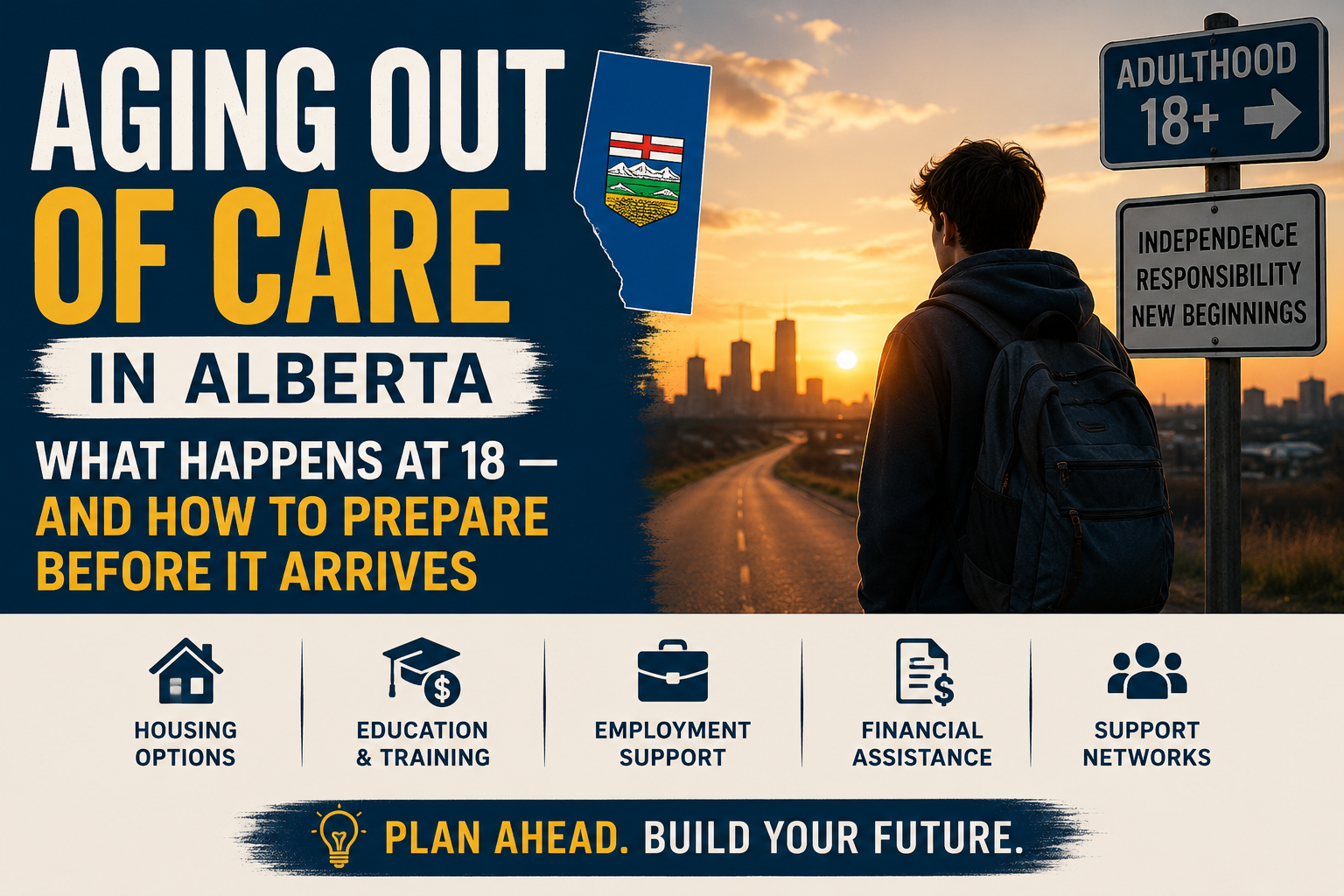
A practical guide for youth in care, and for the caregivers and caseworkers walking beside them.
| QUICK ANSWER Turning 18 in Alberta does not mean support simply stops. Your legal status changes — you are no longer a child in the care of Children’s Services — but Alberta has transition supports for young adults who have been in care, and programs like semi-independent living can provide housing with staff support while you build the skills to live on your own. The most important thing is this: the year before you turn 18 matters more than the day you turn 18. Youth who start planning early, with an adult who is genuinely in their corner, land far more softly than those who wait for the birthday to arrive. |
For most young people, turning 18 is a birthday. For a young person in care, it can feel like a deadline.
You have probably heard the phrase “aging out” used as though it describes something that happens to you — a date on a file, a status that expires. But the young people who come through this transition well are almost never the ones who had the most resources. They are the ones who started preparing early, and who had at least one adult who stayed.
This guide explains what actually changes at 18 in Alberta, what options exist for where you live afterward, and what to do in the twelve months before your birthday. If you are a caregiver or caseworker reading this, the same information applies — the timeline section is written to be used together.
What actually changes when you turn 18?
Legally, you become an adult. You are no longer a child in the care of Children’s Services, and the specific legal arrangement that governed your placement ends.
What that means in practice is that decisions become yours. Where you live, whether you work or study, who you keep in contact with — those are now your calls to make. That is genuinely good news, and it is also a lot to absorb at once, particularly if a lot of decisions have been made for you until now.
What does not automatically happen is that everything stops. Alberta has transition supports for young adults who have been in care, and there are programs designed specifically for this stage. Eligibility, application timing and what is offered can change, so the single most useful thing you can do is ask your caseworker directly what you qualify for — and ask well before your birthday, not after.
| IMPORTANT Some supports have to be applied for before you turn 18, not after. This is the most common and most costly thing young people find out too late. If you take one thing from this article, make it this: ask your caseworker about applications and deadlines at least nine months out. |
Where do youth live after leaving care?
There is no single answer, and the right option depends on how much support you actually want — which is a different question from how much support you think you should need.
| Where Youth Go | What It Looks Like | Who It Suits |
| Semi-independent living | Your own space, with staff support on site or checking in regularly | Youth who want independence but aren’t ready to be fully alone yet |
| Staying with a former caregiver | Remaining with a foster or kinship family past 18 by agreement | Youth with a stable, willing placement and a real relationship |
| Transitional or supportive housing | Shared or single housing with programming attached | Youth needing structure while working or in school |
| Living with family or kin | Returning to or reconnecting with family | Where the relationship is safe and genuinely wanted by both sides |
| Market housing | Renting on your own or with roommates | Youth with income, and ideally someone to call when something breaks |
A note worth saying plainly: choosing a supported option is not a failure. Most 18-year-olds who did not grow up in care are still living at home, still getting meals cooked, still calling a parent when the car makes a noise. Wanting support at 18 is not falling behind. It is the normal amount of support for that age — it just has to be arranged differently.
What is semi-independent living, and where does it fit?
Semi-independent living, often called SIL, sits between full care and living entirely on your own. You have your own space and real independence — your schedule, your food, your choices — with staff available for support, whether that is on site or checking in on a regular basis.
The point of it is practice with a safety net. You learn to manage rent, groceries, appointments and conflict while someone is still there if something goes sideways. For a lot of young people it is the difference between a wobbly first year and a first year that ends in a housing crisis.
It generally suits youth aged roughly 16 to 22 who want to move toward independence but recognise — honestly — that going from a placement straight to a lease is a big jump.
| Thinking about what comes after 18? Changes for Hope runs a trauma-informed, culturally grounded semi-independent living program for youth across Alberta — including Calgary, Edmonton and Red Deer. You can ask questions without committing to anything. Start a conversation at changesforhope.ca |
The twelve months before your birthday
This is the part that actually determines how the transition goes. Caregivers and caseworkers: this table is designed to be worked through together with the young person, not handed to them.
| When | What to Sort Out | Why It Matters Later |
| 12 months before | Gather ID: birth certificate, SIN, health card, status card if applicable | Almost nothing else can be arranged without ID, and replacing it takes time |
| 9 months before | Talk to your caseworker about what supports you may qualify for after 18 | Some supports require an application before your birthday, not after |
| 6 months before | Decide where you want to live and what level of support you want | Good placements have waitlists. Deciding late narrows your options |
| 3 months before | Practise the boring skills — banking, groceries, laundry, appointments | These are the things that quietly overwhelm people in month one |
| 1 month before | Write down your people: who you call for money, rides, advice, a bad night | Isolation is the biggest risk after leaving care, not money |
| After 18 | Keep one consistent adult in your life, whoever that is | Every study on this points the same direction — one steady relationship changes outcomes |
If you are already past some of these markers, that is not a disaster. Start where you are and work through the list. ID first, always — it unlocks almost everything else.
The skills that actually matter
Life skills training sometimes focuses on the impressive-sounding things. In reality, the first months out of care are usually made difficult by very ordinary tasks:
- Banking — opening an account, understanding what a direct deposit is, knowing what happens if you overdraw
- Food — planning meals for a week, shopping to a budget, cooking five things you actually like
- Appointments — booking your own doctor and dentist appointments, and going to them without a reminder
- Housing paperwork — what a lease means, what a landlord can and cannot do, what a damage deposit is
- Conflict — saying no, asking for help, handling a disagreement with a roommate or boss without leaving
None of these are difficult individually. All of them at once, in a new place, with nobody to ask, is what overwhelms people. That is exactly the gap a supported placement is designed to cover.
For Indigenous youth: cultural connection is part of the plan
Indigenous youth are significantly over-represented in Alberta’s care system, and transition planning that ignores culture is incomplete planning.
Connection to community, language, ceremony and family is not an add-on to a transition plan — for many young people it is the thing that holds the rest together. When you are considering a program, ask directly how cultural connection is supported: whether there are relationships with local Nations and Elders, whether ceremony is accessible, and whether staff have genuine cultural competency rather than a training certificate.
A program that treats this as central will answer specifically. One that treats it as a checkbox will answer vaguely. That difference tells you a great deal.
What to look for in a program
- Ask how they handle setbacks — they should be able to describe what trauma-informed practice looks like day to day, not just claim the label
- Ask what happens if a young person struggles — a program that expects perfect behaviour has not understood who it serves
- Ask about staff consistency — relationships are the active ingredient. High turnover undermines everything else
- Ask what success looks like to them — the goal is a person who can stand on their own, not a bed that stays filled
- Ask what support exists afterward — good programs do not end contact abruptly at the exit date
Frequently asked questions
What happens when you turn 18 in foster care in Alberta?
You legally become an adult and are no longer a child in the care of Children’s Services, so decisions about housing, school and work become yours. Support does not automatically end — Alberta has transition supports for young adults who have been in care, and supported housing options such as semi-independent living remain available. Ask your caseworker what you qualify for well before your birthday, as some applications must be made in advance.
Is there support after aging out of care in Alberta?
Yes. Alberta offers transition supports for young adults with care experience, and community organisations across the province run supported housing and life-skills programs. What you qualify for depends on your circumstances and history in care, so speak with your caseworker or contact a youth-serving organisation directly to find out what applies to you.
Where do youth live after leaving foster care?
Common options include semi-independent living with staff support, remaining with a former foster or kinship caregiver by agreement, transitional or supportive housing, living with family or kin where that is safe, and independent market housing. Most young people do better with a supported option first rather than moving straight to a lease.
What is semi-independent living for youth?
Semi-independent living gives a young person their own space and real day-to-day independence while staff remain available for support, either on site or through regular check-ins. It typically serves youth aged roughly 16 to 22 and is designed as practice with a safety net — managing rent, food, appointments and conflict before doing it entirely alone.
How do I prepare to age out of care?
Start about twelve months out. Gather your ID first — birth certificate, SIN, health card and status card if applicable — because little else can be arranged without it. Then ask your caseworker about supports and application deadlines, decide where you want to live by around six months out, practise everyday skills like banking and cooking, and identify the specific people you will call when you need help.
Can I stay with my foster family after I turn 18?
In some cases, yes, by agreement between you and your caregivers, and depending on the arrangements available. This works well when the relationship is stable and both sides genuinely want it. Raise it early with your caseworker and your caregivers rather than assuming either way, so there is time to make arrangements properly.
| You do not have to figure this out alone. Changes for Hope supports youth aged 16–22 across Alberta with semi-independent living built on respect, cultural identity, and the belief that every young person deserves a real shot at independence. Reach out at changesforhope.ca — questions are welcome, commitment is not required |